

Searched for: IXἈρὲδ
translit : IXAred
trans-greeked : ἸΞΑρὲδ
Samekhi English Gematria=819


Search - Search - Search -

Entries found: 1

IXἈρὲδ

Ixard

The form IXἈρὲδ is a lemma, possibly from an inscription or manuscript, where 'IX' indicates the letter Iota followed by ten other characters. The modern gloss 'Ixard' represents a phonetic interpretation of this ancient Greek name.

Translation by: WizardLM2:7B

I(I)

Name: LATIN CAPITAL LETTER I
Unicode: U+73
Number: 9
Translit: I
Language: i-klingon
Readable: i
Description:

1. The letter "I" as we know it today originated from the Phoenician letter "yod," which meant "hand." It was later adopted into the Greek alphabet as the letter "iota," and eventually into the Latin alphabet as "I." 2. In esoteric and mystical traditions, the letter "I" has been associated with concepts such as individuality, self-awareness, and the idea of the self as a separate entity. In Kabbalistic teachings, "I" can symbolize the divine spark within each individual, representing the connection between the individual and the divine. 3. The letter "I" has been used symbolically in various ancient and modern traditions. In ancient Roman numerals, "I" represented the number 1. In alchemy, "I" has been associated with the concept of the primal self or the beginning of transformation. In some modern spiritual practices, the letter "I" is used in visualization exercises to focus on the self and one's inner identity.


X(X)

Name: LATIN CAPITAL LETTER X
Unicode: U+88
Number: 700
Translit: X
Language: so
Readable: Ψ
Description:

The letter/symbol "X" has its linguistic origin in the Phoenician letter "samekh," which meant "fish." It later evolved into the Greek letter "chi," symbolizing the sound "kh." In terms of symbolic meaning, "X" has been associated with crossing, intersection, and balance. In esoteric and spiritual traditions, it represents the meeting point between the physical and spiritual realms, symbolizing transformation and change. The symbol has been used in various ancient and modern traditions, such as alchemy, where it signifies the union of opposites, and in mathematics to represent multiplication or an unknown variable.


Ἀ(A)

Name: GREEK CAPITAL LETTER ALPHA WITH PSILI
Unicode: U+7944
Number: 1
Translit: A
Language: el
Readable: a
Description:

The letter or symbol "Ἀ" is the uppercase form of the Greek letter alpha. It has its linguistic origin in the Greek alphabet, where it represents the first letter and the sound /a/. In Ancient Greek, it was used as a numeral symbol for 1. In terms of esoteric or spiritual meanings, the letter alpha has been associated with concepts such as beginnings, primacy, and creation. In Kabbalistic traditions, the first letter of the Hebrew alphabet, aleph, is seen as a symbol of divinity and unity, mirroring the symbolism of alpha. Symbolically, the alpha symbol has been used in various ancient and modern traditions to represent leadership, strength, and the source of all things. It can be found in religious and mystical contexts, denoting the origin or the highest rank in a hierarchy. Overall, the symbol "Ἀ" carries the significance of beginnings and power, both linguistically and symbolically, making it a potent and meaningful symbol across cultures and traditions.


ρ(r)

Name: GREEK SMALL LETTER RHO
Unicode: U+961
Number: 100
Translit: r
Language: el
Readable: r
Description:

The letter or symbol ρ, called "rho," has its origins in the Greek alphabet, where it represents the sound /r/. In esoteric and spiritual traditions, rho can be seen as a symbol of resurrection, renewal, or transformation due to its resemblance to a staff or a scepter. In addition, in Kabbalistic traditions, rho may represent the idea of reflection, as it is a mirror image of the letter "P" in the Hebrew alphabet, which corresponds to the mouth and speech in the mystical interpretation of the Tree of Life. Throughout history, rho has been used symbolically in various ancient and modern traditions. In ancient Greek culture, it was sometimes associated with the sun god Helios. In Christianity, rho is known as the Chi-Rho symbol, representing the first two letters of the Greek word for Christ. It has also been used in alchemy and astrology to symbolize change and transmutation.


ὲ(e)

Name: GREEK SMALL LETTER EPSILON WITH VARIA
Unicode: U+8050
Number: 5
Translit: e
Language: el
Readable: e
Description:

The letter symbol ὲ is known as "epsilon with varia" in Ancient Greek. 1. Linguistic Origin: It is a lowercase variant of the Greek letter Epsilon with a smooth breathing mark (varia) on top. Epsilon is the fifth letter of the Greek alphabet and has a numerical value of 5. 2. Esoteric/Spiritual Meaning: In esoteric and Kabbalistic traditions, the letter Epsilon is associated with the number 5, representing balance and harmony. The varia diacritic symbolizes an emphasis on a specific pronunciation or meaning in ancient texts, suggesting a nuanced or deeper interpretation. 3. Symbolic Use: In ancient Greek texts, the letter Epsilon (ὲ) with varia could signify a variation in pronunciation, stress, or emphasis on certain words. Its use was primarily linguistic rather than symbolic in mainstream traditions. However, in esoteric interpretations, the letter might carry symbolic significance related to the concepts of balance, emphasis, or hidden meanings within texts. Overall, while ὲ is primarily a linguistic element in Ancient Greek, its combination with the varia diacritic could potentially hold esoteric or spiritual connotations in interpretive frameworks.


δ(d)

Name: GREEK SMALL LETTER DELTA
Unicode: U+948
Number: 4
Translit: d
Language: el
Readable: d
Description:

The letter "δ" is the fourth letter of the Greek alphabet, known as "delta." It has its origins in the Phoenician letter "daleth," which meant "door" or "entrance." In Greek, "delta" came to represent the consonant sound /d/. In terms of esoteric or spiritual meanings, "delta" is associated with the concept of change, transformation, and transition. This symbolism is derived from the triangular shape of the letter, resembling a doorway or a pyramid, suggesting a passage from one state to another. In ancient Greek philosophy, "delta" was sometimes used to represent the number four, which was considered a symbol of perfection and stability due to its symmetry. In modern times, the symbol "δ" is commonly used in scientific contexts, such as representing change or difference in mathematics and physics. Overall, the letter "δ" carries a dual symbolism of transition and stability, making it a versatile and meaningful symbol in various contexts throughout history.


The Septuagint, Byzantine, & KJV Bibles used are in the Public Domain.

1 Adam and Eve    1 Baruch    1 Chronicles    1 Corinthians    1 Enoch    1 Esdras    1 Ezra    1 Hermas    1 John    1 Kings    1 Maccabees    1 Peter    1 Samuel    1 Thessalonians    1 Timothy    2 Adam and Eve    2 Baruch    2 Chronicles    2 Corinthians    2 Enoch    2 Esdras    2 Ezra    2 Hermas    2 John    2 Kings    2 Maccabees    2 Peter    2 Samuel    2 Thessalonians    2 Timothy    3 Baruch    3 Enoch    3 Hermas    3 John    3 Maccabees    4 Baruch    4 Maccabees    Acts    Acts24    Additions to Esther 10    Amos    Apocalypse of Peter    Baruch    Bel Dragon Theodotio    Bel and the Dragon    Colossians    Daniel    Daniel Theodotionis    Deuteronomy    Ecclesiastes    Ephesians    Esther    Exodus    Ezekiel    Ezra    Galatians    Genesis    Habakkuk    Haggai    Hebrews    Hosea    Isaiah    James    Jasher    Jeremiah    Job    Joel    John    Jonah    Jonas    Joshua    Jubilees    Jude    Judges    Judith    Lamentations    Letter of Jeremiah    Leviticus    Luke    Malachi    Mark    Matthew    Micah    Nahum    Nehemiah    Numbers    Obadiah    Odes    Pericopa Adulterae    Philemon    Philippians    Prayer of Azariah    Prayer of Manasseh    Proverbs    Psalms    Psalms of Solomon    Revelation    Romans    Ruth    Sirach    Song of Solomon    Song of Songs    Songs    Susanna    Susanna Theodotionis    Testament of Solomon    The Apocalipse of Sedrach    The Ascension of Isaiah    The Testament of Asher    The Testament of Benjamin    The Testament of Dan    The Testament of Gad    The Testament of Issachar    The Testament of Joseph    The Testament of Judah    The Testament of Levi    The Testament of Naphtali    The Testament of Reuben    The Testament of Simeon    The Testament of Zebulun    Titus    Tobit    Wisdom    Wisdom of Solomon    Zachariah    Zechariah    Zephaniah   


Total Execution Time: 0.11200308799744 Seconds

How to support this Ministry?

Surplus by Samekhi
Spectrum Bill per month: $507.00 3 ip's not including electricity cost or rent
Our Servers & Software Cost: $259.00 per month not including labor

Cash app $SamekhiAmI

Donate with Cash App

$

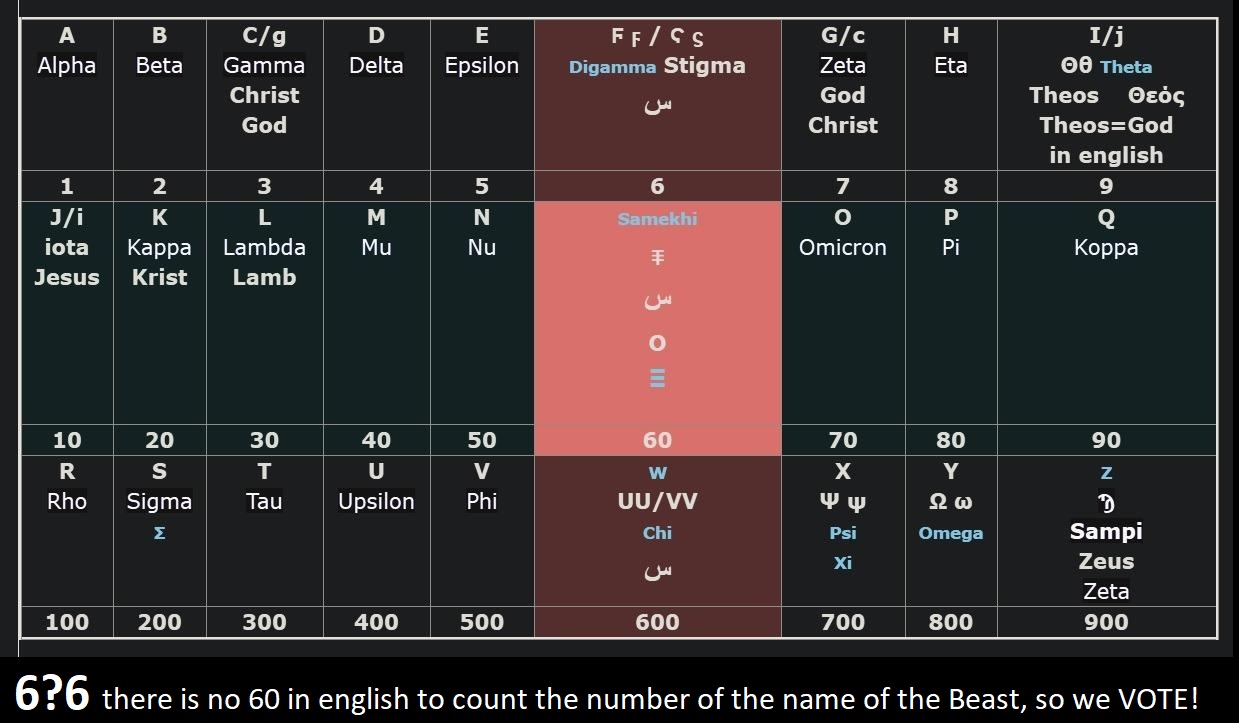
In the Greek numbering system of the ancient Greek alphabet, the last letter is ϡ (sampi). The fourth letter before sampi is Χ (chi). Therefore, Χ (chi) is the fourth letter from the last letter in the Greek numbering system and has a numerical value of 600. In the Greek alphabet, sampi (ϡ) is the final letter and has a numerical value of 900. In the modern English alphabet, the last letter is Z. The fourth letter before Z is W. Therefore, W is the fourth letter from the last letter in the English alphabet and has a numerical value of 600.

Here are some words that equal 666 and 616 using W as 600 in English gematria:

Donate w/ Cash App

$

The Samekhi Papers

Welcome to the digital archaeology of ancient texts. Here we decode manuscripts, reveal hidden meanings, and challenge 2000 years of Biblical interpretation.

Our latest discoveries include the P47 manuscript analysis that questions the traditional 666 interpretation, the revelation that ψηφίζω means "vote" not "calculate," and the Gothic Christmas connections that change everything we thought we knew about Weihnachten.

This is legitimate Biblical archaeology using modern digital tools to uncover what ancient scribes really wrote.